Engineered for Life: The Biomechanics and Economics of Dental Implants, Walked Through Slide by Slide
Every permanent tooth replacement is, at its core, an engineering problem: how do you rebuild a structure that must bear a lifetime of force, integrate with living tissue, and hold its value for decades? That's the question this blueprint-style deck answers — and this walkthrough follows it slide by slide, the way an architect walks you through a set of plans. From the biological reality of missing teeth to the 25-year cost of ownership, the materials, the timeline, the hidden fees, and the maintenance that keeps the structure standing, here is the complete architecture of the modern dental implant.
Slide 1 — Engineered for Life: The Blueprint
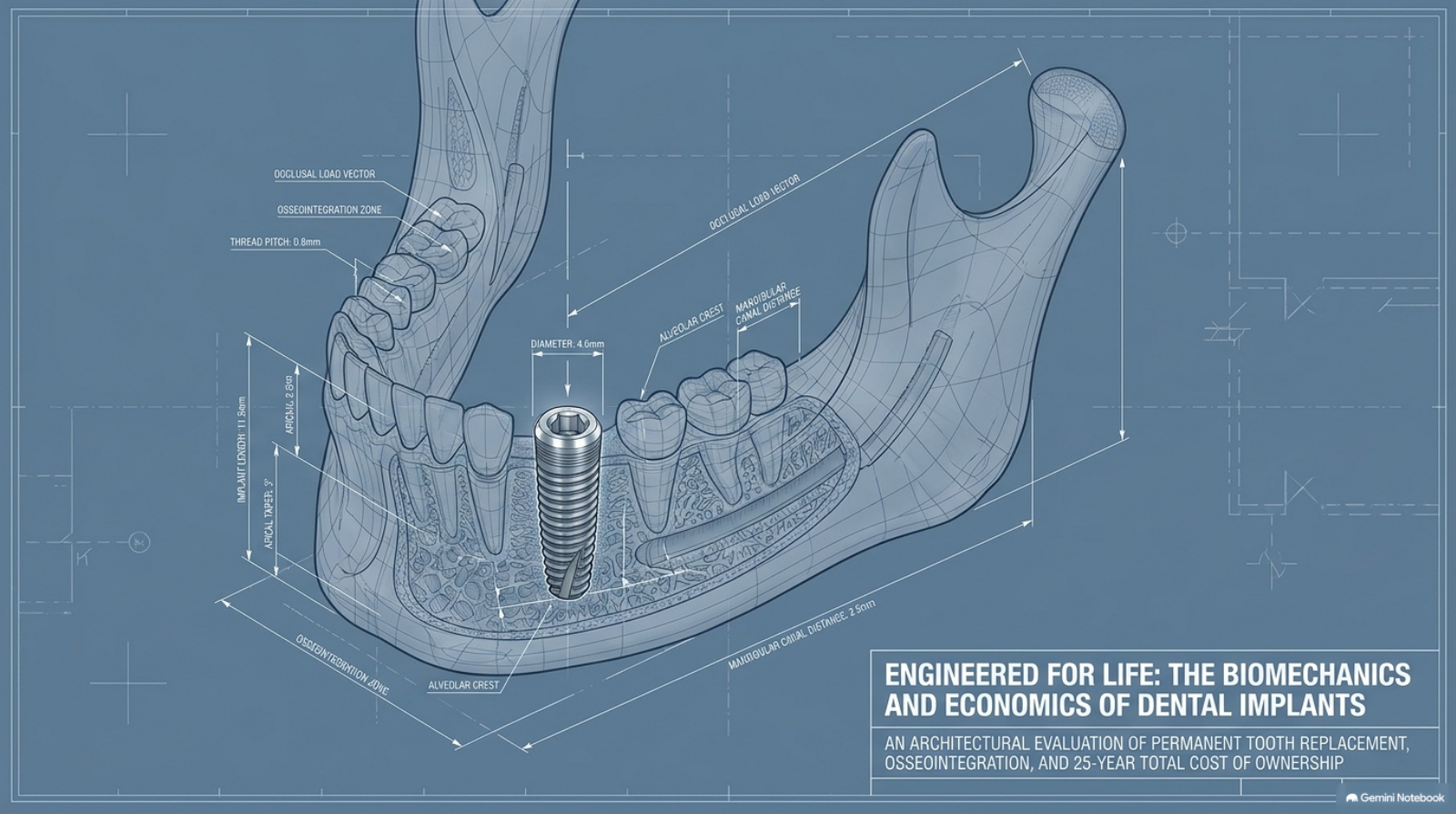
The deck opens with its thesis: dental implants are not a cosmetic procedure, they are a piece of structural engineering — and the economics of that engineering matter as much as the biomechanics. The title slide sets up the two pillars the entire presentation will rest on: how a titanium root fuses with living bone (osseointegration), and what that fusion is worth over 25 years of total cost of ownership. Everything that follows is a deepening of that single idea — that a tooth replacement is an investment in permanent infrastructure, not a purchase of a temporary part.
Slide 2 — The Biological Reality of Missing Teeth: Structural Atrophy
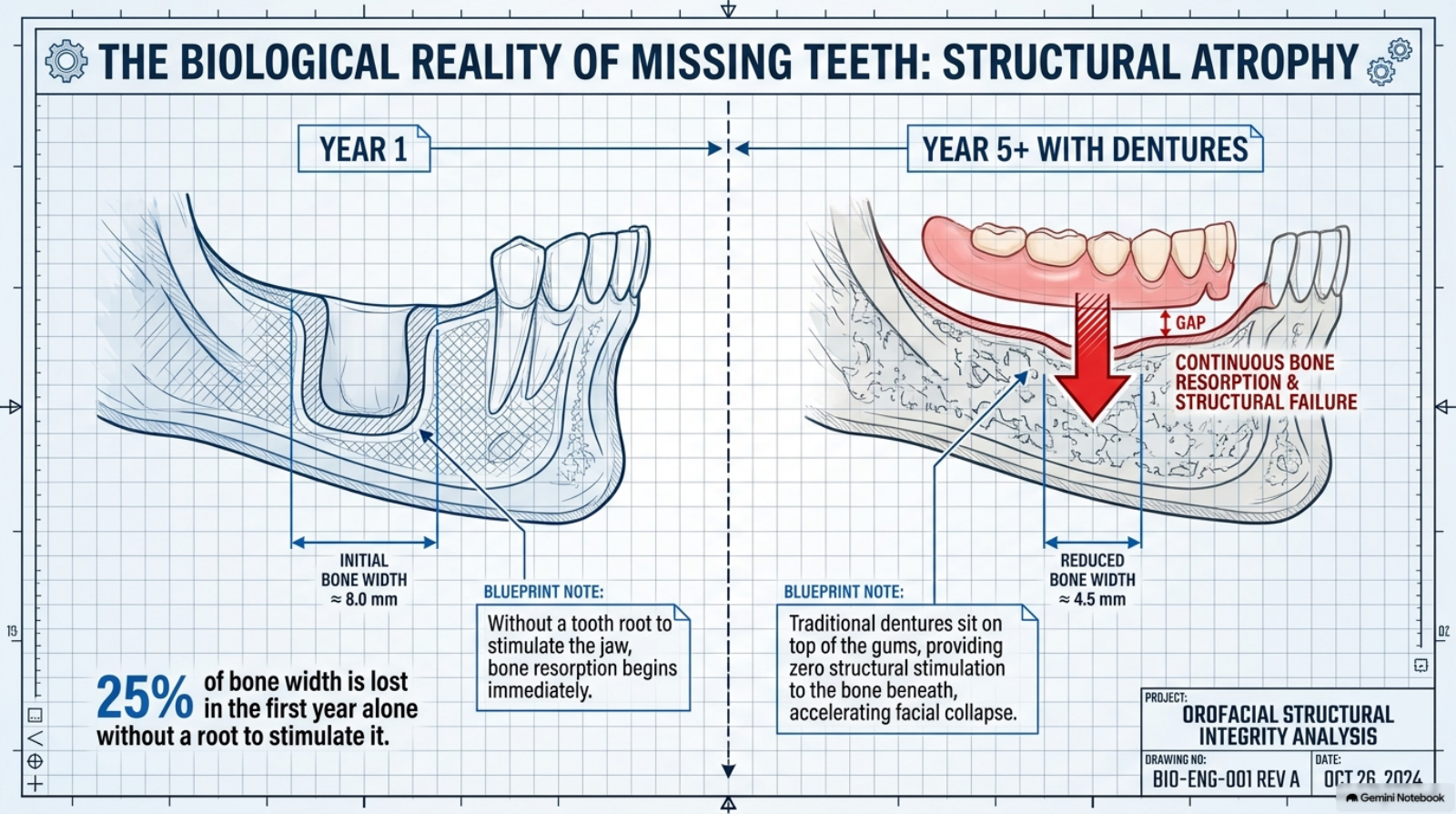
Before any solution, the problem. When a tooth is lost, the jawbone in that spot begins to dissolve — the root was the stimulus that kept bone alive, and without it, resorption begins immediately. The numbers are stark: roughly 25 percent of bone width is lost in the first year alone, with a typical ridge narrowing from about 8 millimeters to 4.5 millimeters within five years. And here is the part that surprises most people: traditional dentures do nothing to stop this. They rest on the gum surface, providing zero structural stimulation to the bone beneath. The result is a slow, invisible collapse — the reason longtime denture wearers develop the classic sunken facial profile. This slide is the deck's warning: any replacement that doesn't preserve bone isn't really a replacement at all.
Slide 3 — Osseointegration Transforms Titanium Into a Living Foundation
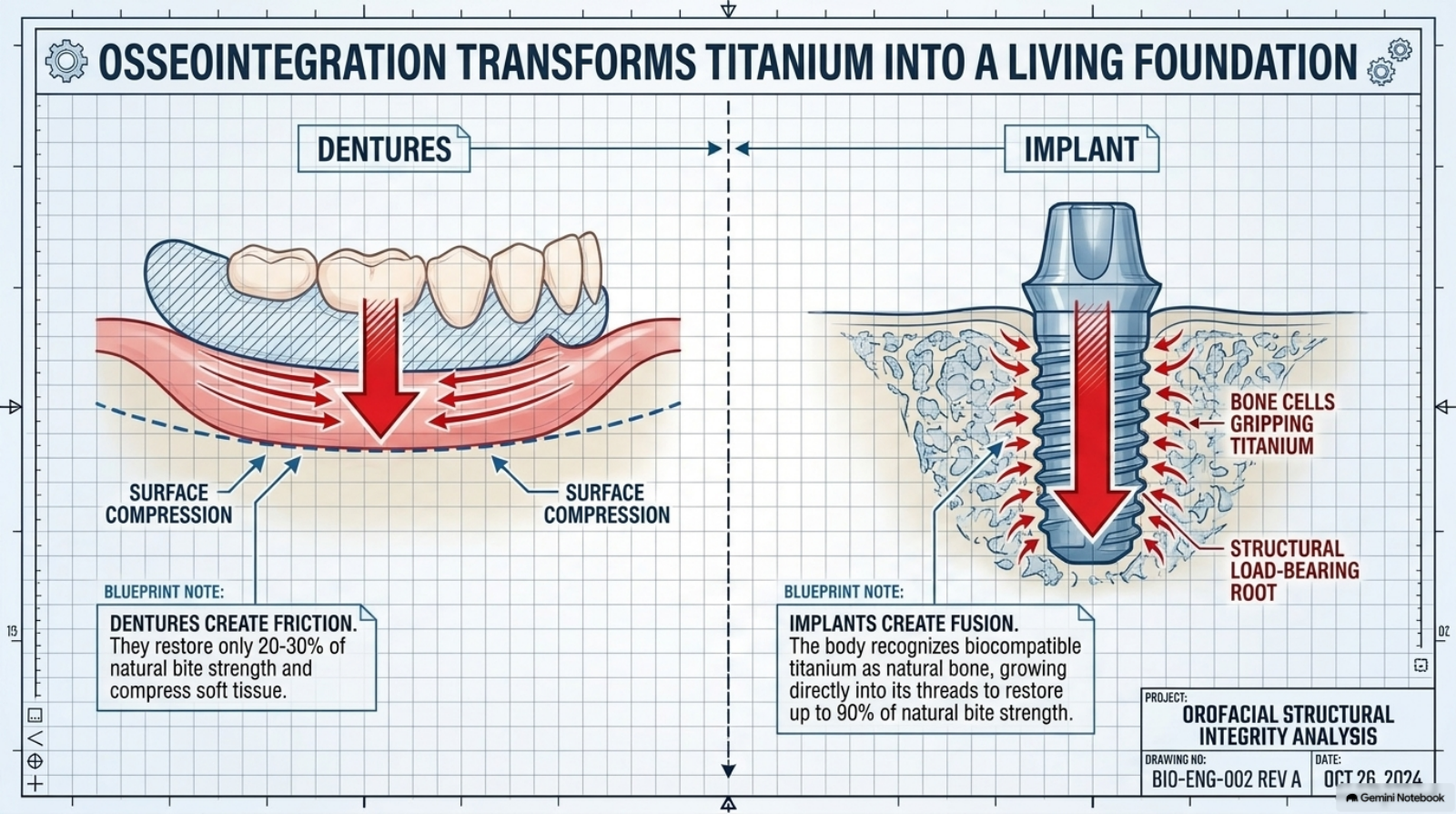
The contrast could not be sharper. Dentures create friction: they compress soft tissue and restore only 20 to 30 percent of natural bite strength. Implants create fusion: the body recognizes biocompatible titanium as natural bone and grows directly into its threads, restoring up to 90 percent of natural bite force. That single word — fusion versus friction — explains nearly everything about why the two options age so differently. Friction wears; fusion heals. This is the moment in the deck where the architecture metaphor becomes literal: the implant isn't resting on the ground, it's becoming part of it.
Slide 4 — Mapping Your Structural Requirements to the Right Solution
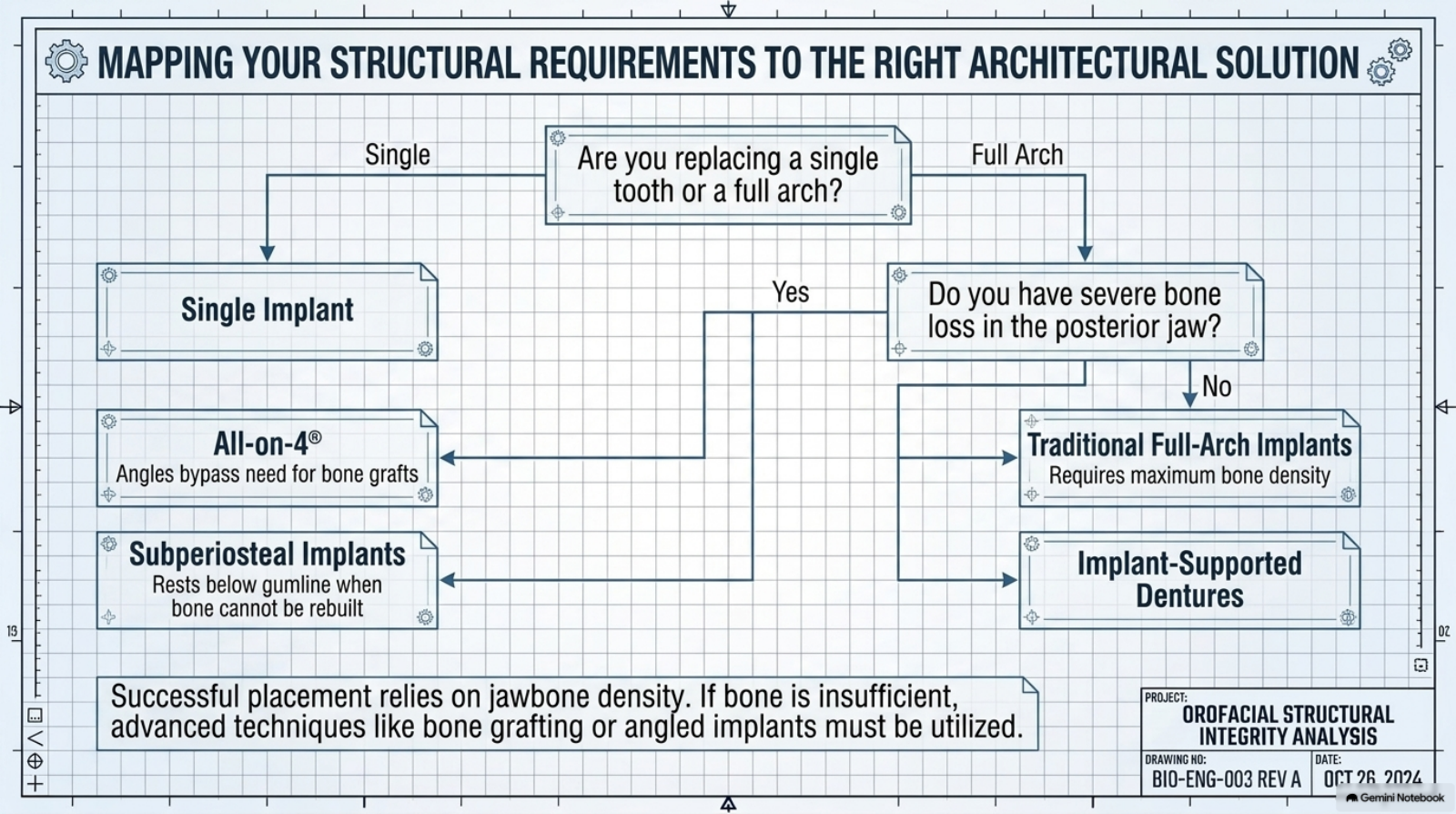
Not every patient needs the same build. The deck's decision tree starts with a simple fork: are you replacing a single tooth or a full arch? Single tooth points to a standard implant; full arch branches again on bone condition. With adequate posterior bone, traditional full-arch implants work. With severe posterior bone loss, the tree routes to options engineered for exactly that problem — All-on-4's angled placements, implant-supported dentures for compromised bone, and subperiosteal implants as the last resort when bone cannot be rebuilt at all. The principle under every branch: successful placement depends on jawbone density, and when bone is insufficient, advanced techniques like grafting or angulation must close the gap. The right solution is the one your own anatomy dictates — which is why the CBCT scan comes before any recommendation.
Slide 5 — Objective Evaluation of Full-Arch Replacement Options
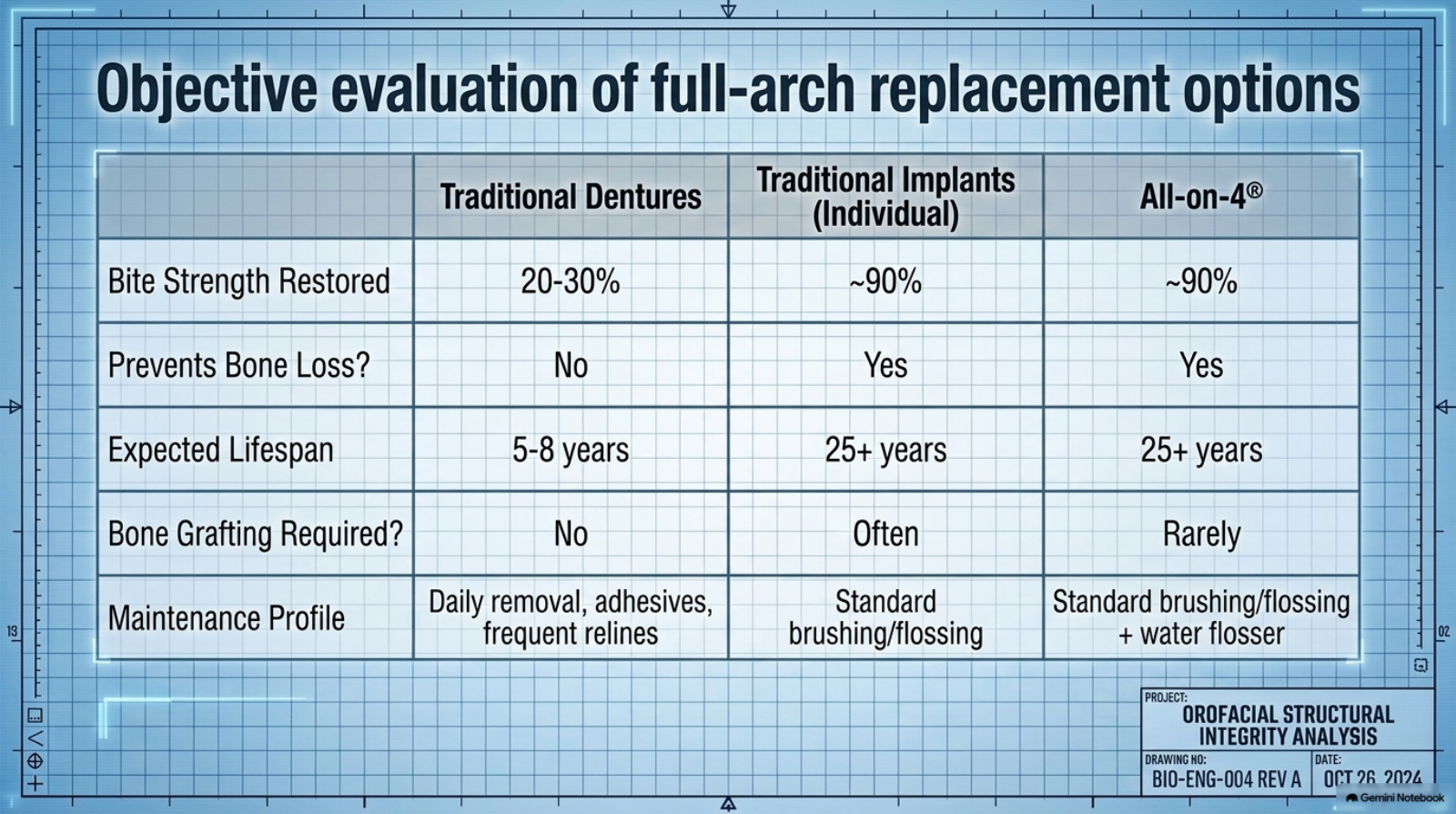
Now the deck goes head-to-head. Dentures restore 20 to 30 percent of bite strength, do not prevent bone loss, and last five to eight years before replacement — with a maintenance profile of daily removal, adhesives, and frequent relines. Traditional implants restore roughly 90 percent of bite strength, prevent bone loss, and carry a 25-year-plus lifespan, but often require bone grafting. All-on-4 matches those clinical outcomes while rarely needing grafting at all, thanks to its angled posterior implants. The table is the deck's most persuasive slide because it's honest: the least invasive option is also the least effective, and the most effective options are distinguished mainly by how well they adapt to compromised bone.
Slide 6 — The Structural Engineering Behind All-on-4 Efficiency
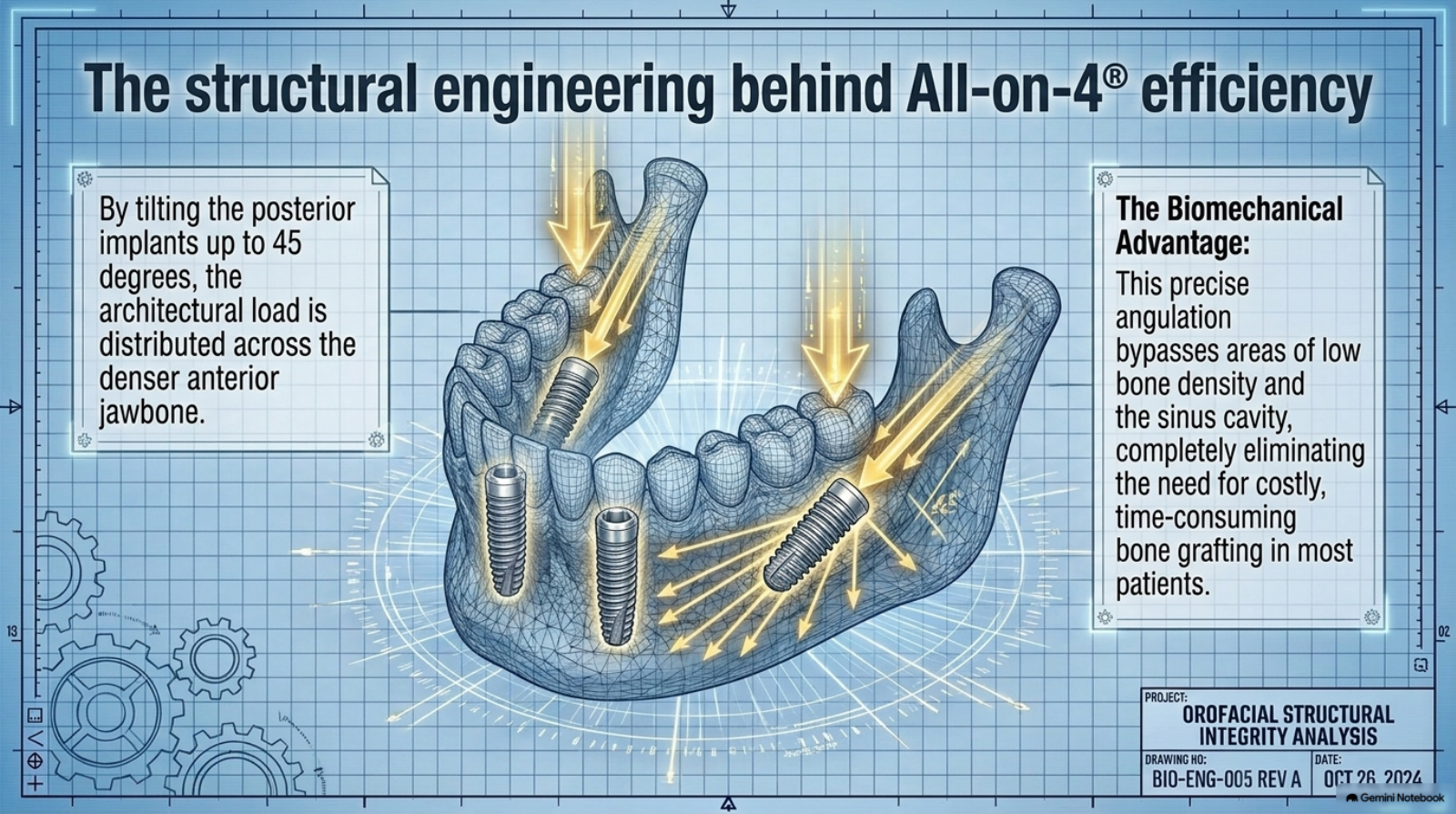
Here is the trick that makes All-on-4 work: the two posterior implants are tilted at a 45-degree angle, anchoring into the denser anterior jawbone rather than the weaker rear sections. This angulation does three things at once — it distributes occlusal load across the strongest available bone, it bypasses the sinus cavities entirely, and it eliminates the need for bone grafting in most patients. It's a genuinely elegant piece of engineering: instead of building up the foundation, the design simply chooses better ground. For patients, the payoff is measurable — shorter treatment time, fewer procedures, and a lower overall cost.
Slide 7 — Selecting the Prosthetic Superstructure: Materials Matter
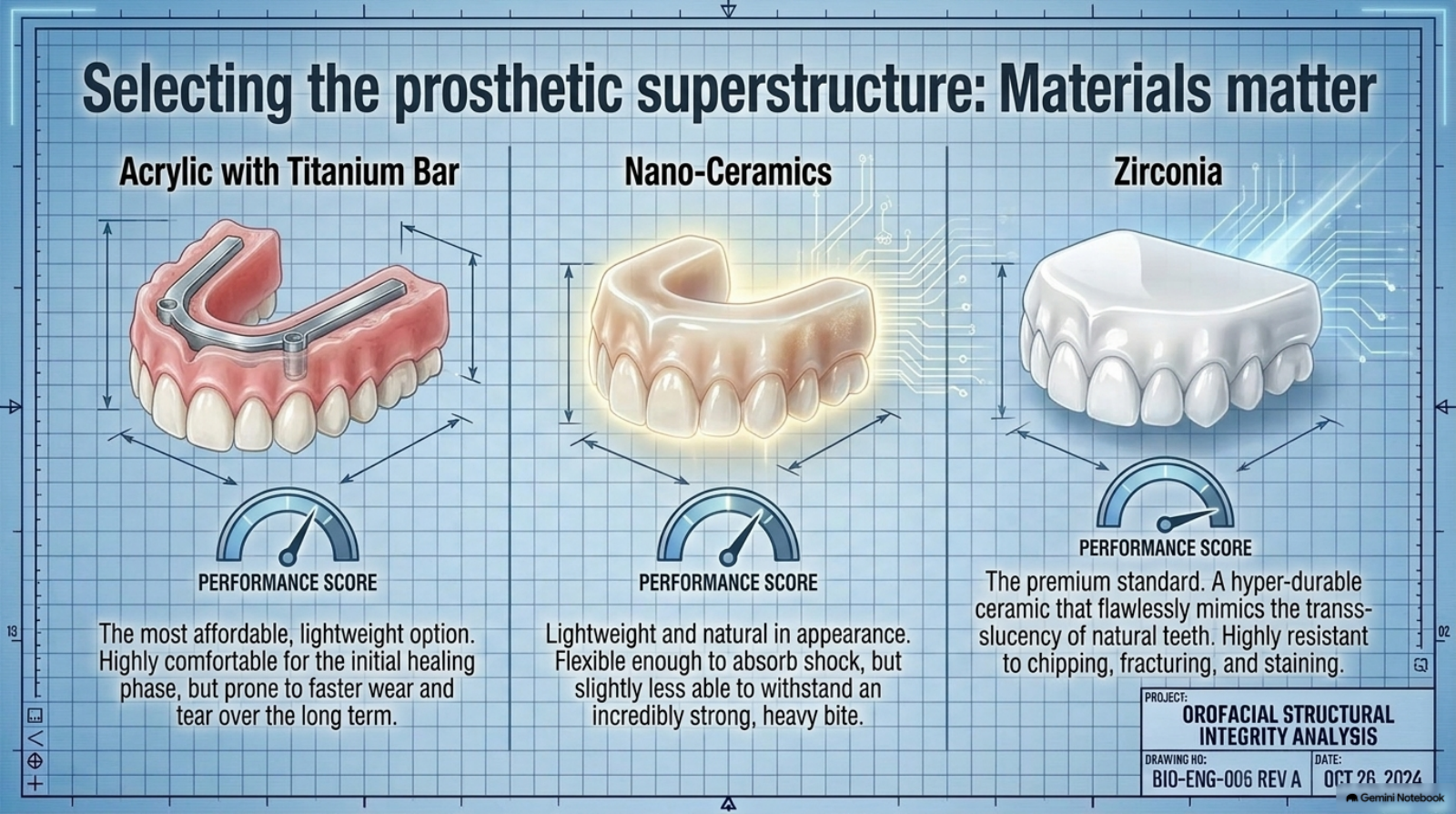
The implant is the foundation; the teeth on top are the superstructure, and the material choice matters more than most patients realize. Acrylic over a titanium bar is the most affordable and comfortable option — ideal for the healing phase — but it wears faster over the long term. Nano-ceramics split the difference: lightweight, natural-looking, and flexible enough to absorb shock, though slightly less resistant to the heaviest bites. Zirconia is the premium standard — a hyper-durable ceramic that mimics natural tooth translucency and resists chipping, fracturing, and staining. The lesson of this slide: your provider's material selection is a quality decision that will follow you for decades, and it's worth asking exactly what your final teeth will be made of before you commit.
Slide 8 — The Financial Blueprint: Upfront Price vs. 25-Year Total Cost of Ownership
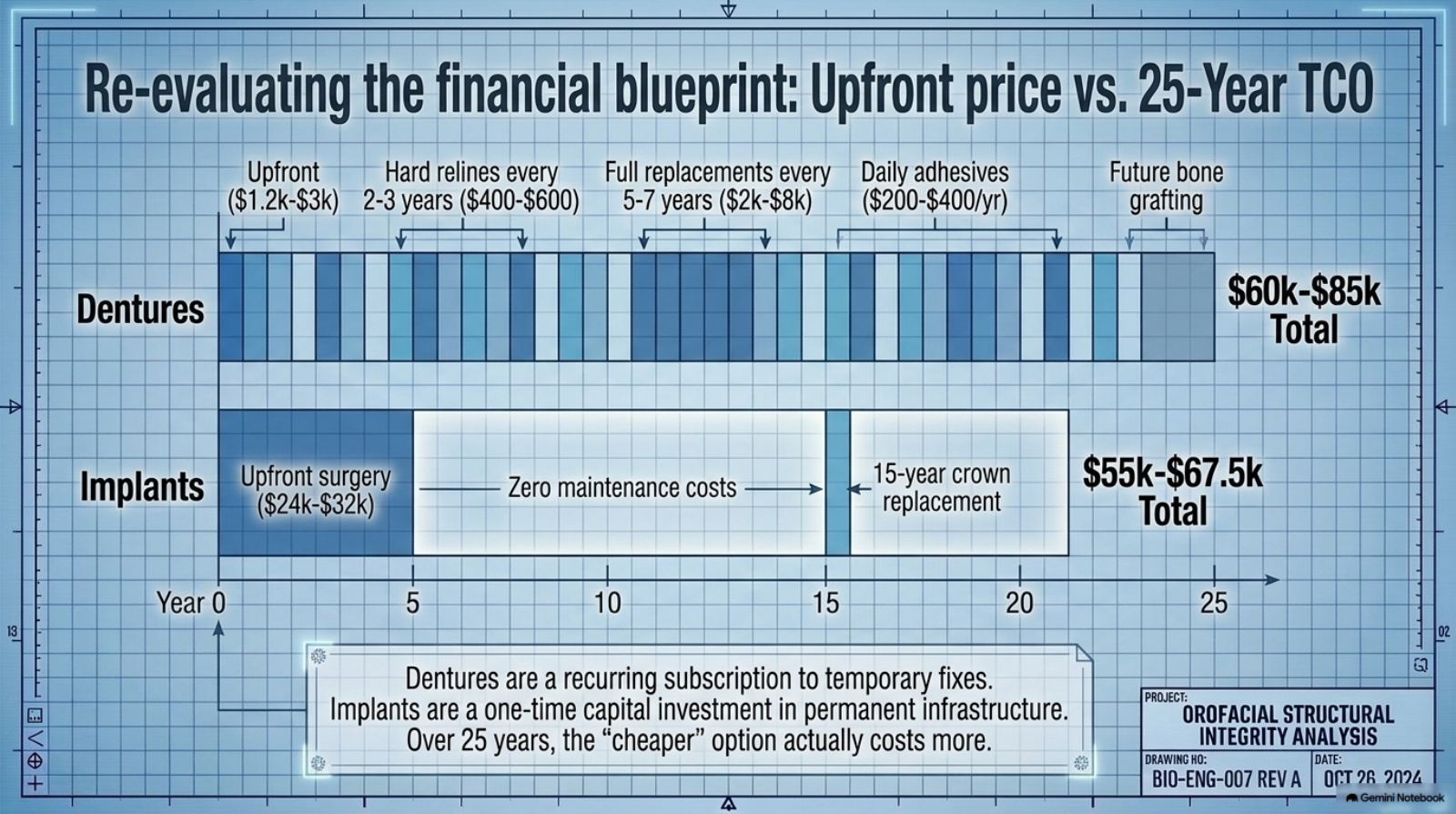
This is the slide that reframes the entire cost conversation. Dentures look cheap at the counter — $1,200 to $3,000 upfront — but they are a subscription, not an asset: hard relines every two to three years, full replacements every five to seven years, daily adhesives at $200 to $400 a year, and eventual bone grafting on top. Over 25 years, that recurring spend totals $60,000 to $85,000. Implants cost more upfront — $24,000 to $32,000 for surgery — but maintenance is effectively zero for the first 15 years, with a single crown replacement event around year 15. The 25-year total: $55,000 to $67,500. The deck's caption says it best: dentures are a recurring subscription to temporary fixes; implants are a one-time capital investment in permanent infrastructure. Over 25 years, the cheaper option actually costs more.
Slide 9 — Unpacking the Initial Investment: What Your Quote Actually Covers
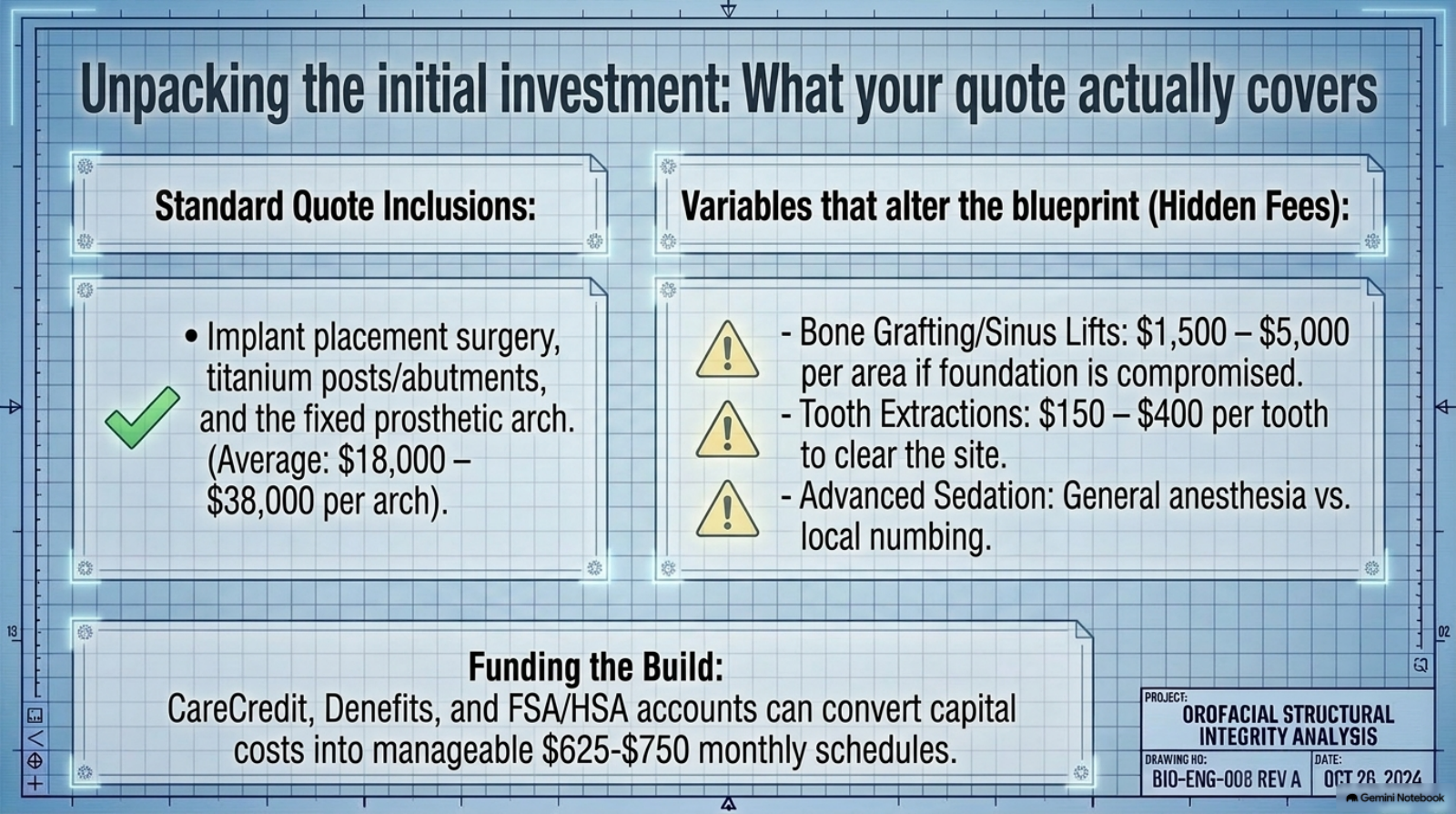
Speaking of costs — here is where transparency matters. A standard full-arch quote of $18,000 to $38,000 includes the implant placement surgery, the titanium posts and abutments, and the fixed prosthetic arch. But the quote may not include the variables: bone grafting or sinus lifts at $1,500 to $5,000 per area, tooth extractions at $150 to $400 per tooth, and advanced sedation, which varies widely. The deck's advice is the practical one: treat the itemized quote as a non-negotiable. And for the funding side, options like CareCredit, Denefits, and FSA/HSA accounts convert the capital cost into monthly payments in the $625 to $750 range — turning a structural investment into a manageable line item.
Slide 10 — The Construction Timeline: Symptoms vs. Biological Healing
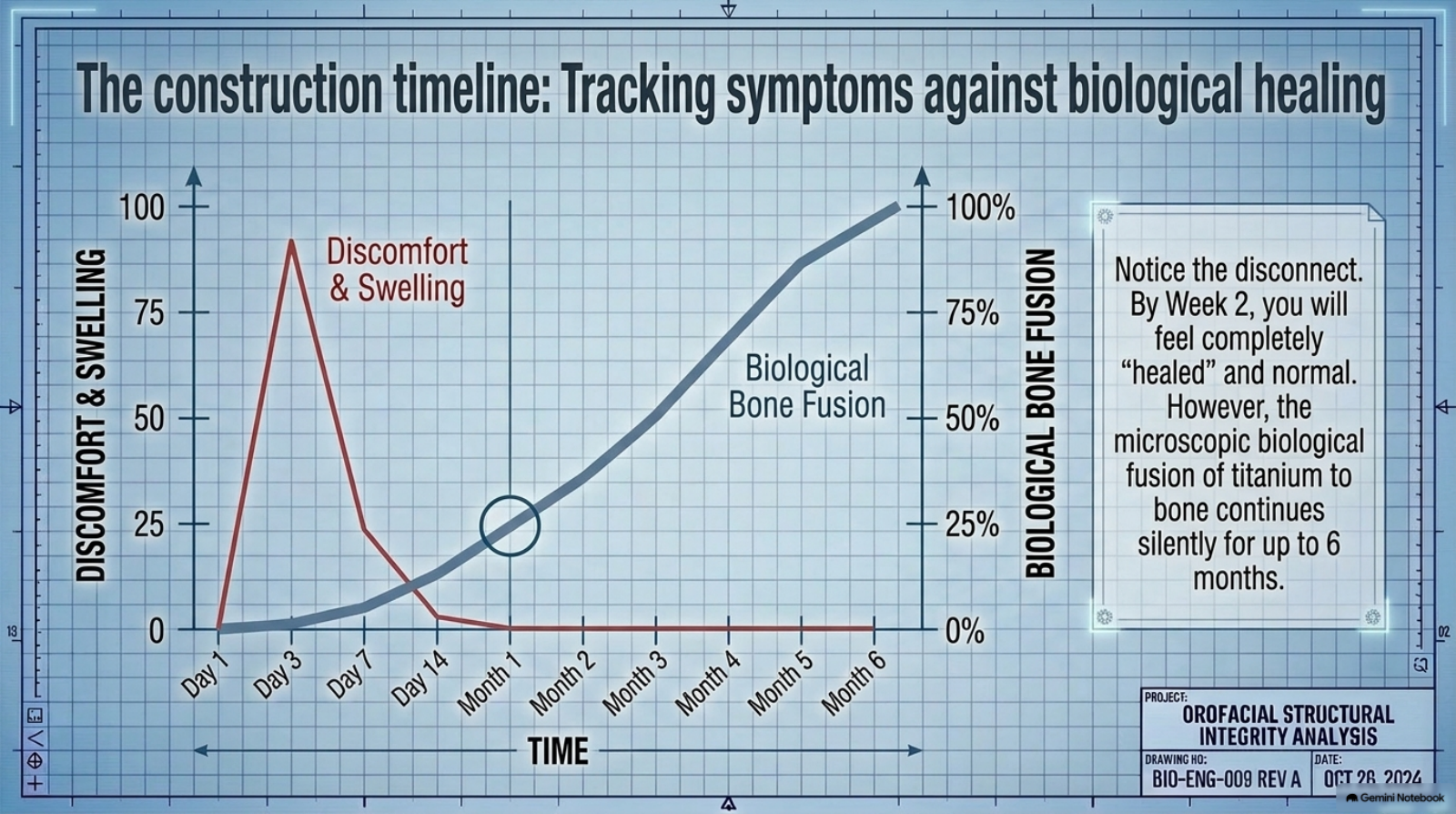
One of the most important graphs in the deck plots two curves on the same six-month timeline. The red line — discomfort and swelling — spikes sharply around day three, then collapses to near zero by day fourteen. The blue line — biological bone fusion — starts at zero and climbs steadily, reaching only about 25 percent at month one and 100 percent at month six. The clinical disconnect is the lesson: by week two, patients feel completely healed, while the microscopic fusion of titanium to bone continues silently for months. Feeling fine is not the same as being finished — which is exactly why the next slides lay out what the healing phases actually require.
Slide 11 — Phase 1: The Critical First 7 Days of Site Management
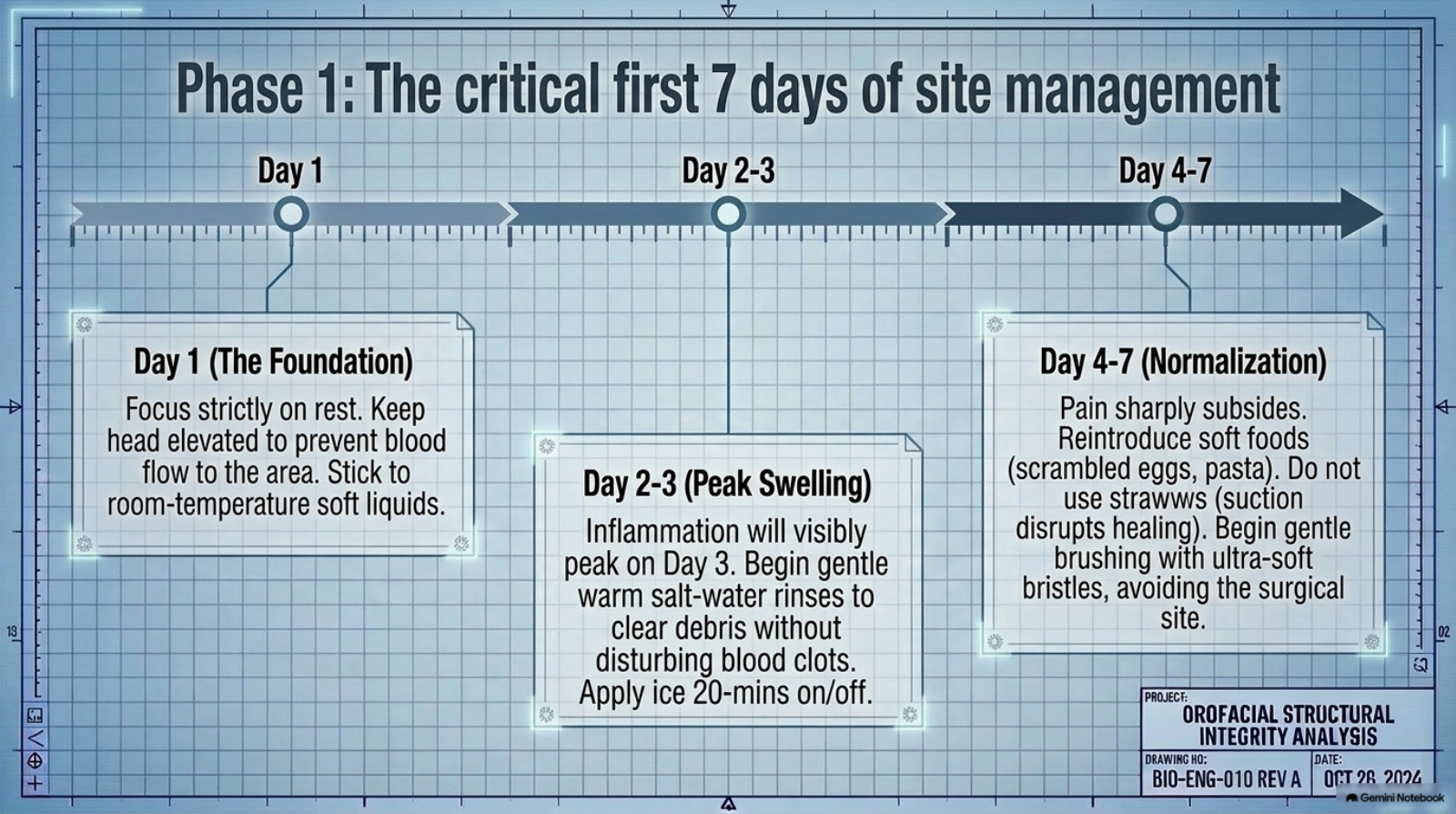
The first week is the foundation of everything. Day one is rest: head elevated to limit blood flow to the area, room-temperature soft liquids only. Days two and three are when swelling peaks — inflammation visibly crests on day three — and the protocol is gentle warm salt-water rinses to clear debris without disturbing the blood clot, plus ice in 20-minute on/off intervals. Days four through seven bring normalization: pain subsides sharply, soft foods like scrambled eggs and pasta return, and the rules are simple — no straws, because suction disrupts the healing site, and gentle brushing with ultra-soft bristles, staying clear of the surgical area. Get this week right and every later phase goes smoother.
Slide 12 — Phase 2: Biological Fusion and Osseointegration (Weeks 5–12)
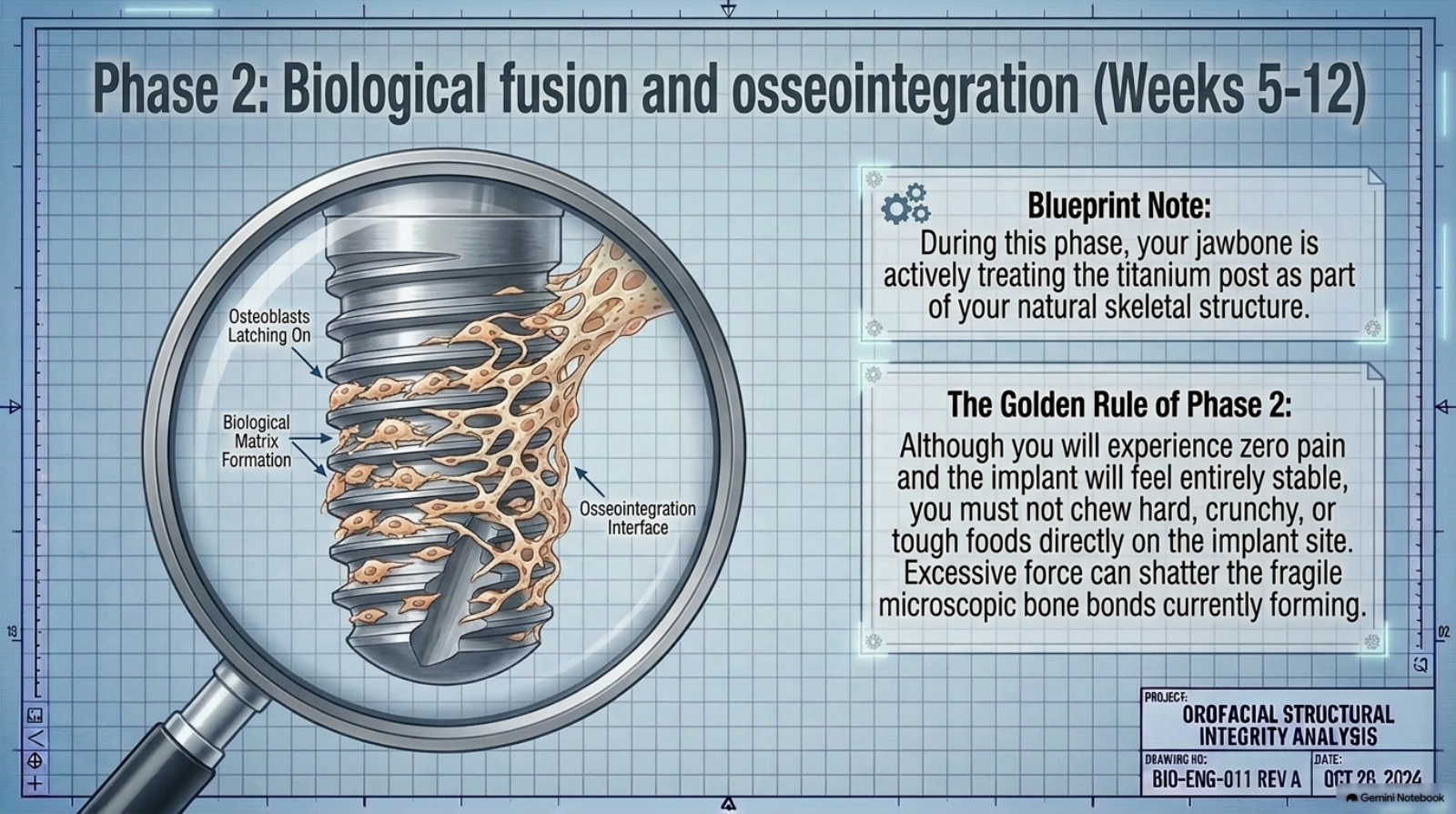
By weeks five through twelve, the visible recovery is long over — but the real work is happening at the microscopic level. Osteoblasts — bone-building cells — latch onto the titanium surface and lay down a biological matrix, and the jawbone begins treating the implant as part of the natural skeleton. This is osseointegration in action, and the deck's golden rule for this phase is blunt: despite zero pain and complete stability, do not chew hard, crunchy, or tough foods directly on the implant site. The bone bonds forming now are fragile, and excessive force can shatter them before they mature. The implant feels permanent; biologically, it's still under construction.
Slide 13 — Phase 3: The Finished Build and Permanent Restoration (Months 3–6)
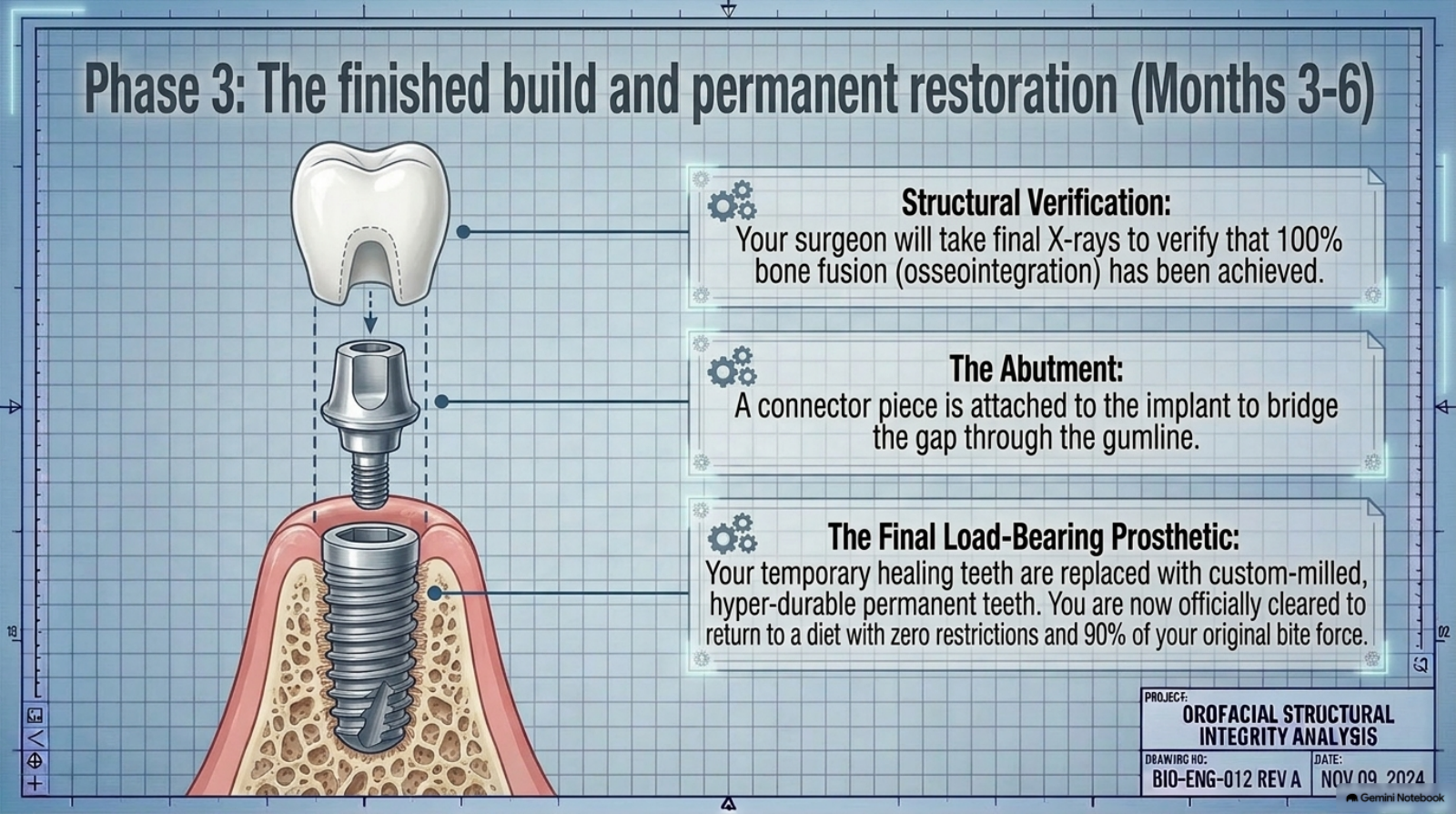
Months three through six are the reveal. A final X-ray confirms 100 percent bone fusion — structural verification that the implant is fully integrated. The abutment — the connector piece that bridges the implant through the gumline — is attached, and the temporary healing teeth are replaced with custom-milled permanent restorations. From this point, the patient is cleared for an unrestricted diet and restored to roughly 90 percent of original bite force. The blueprint is complete: foundation verified, superstructure installed, structure signed off.
Slide 14 — Protecting the Asset: Long-Term Infrastructure Maintenance
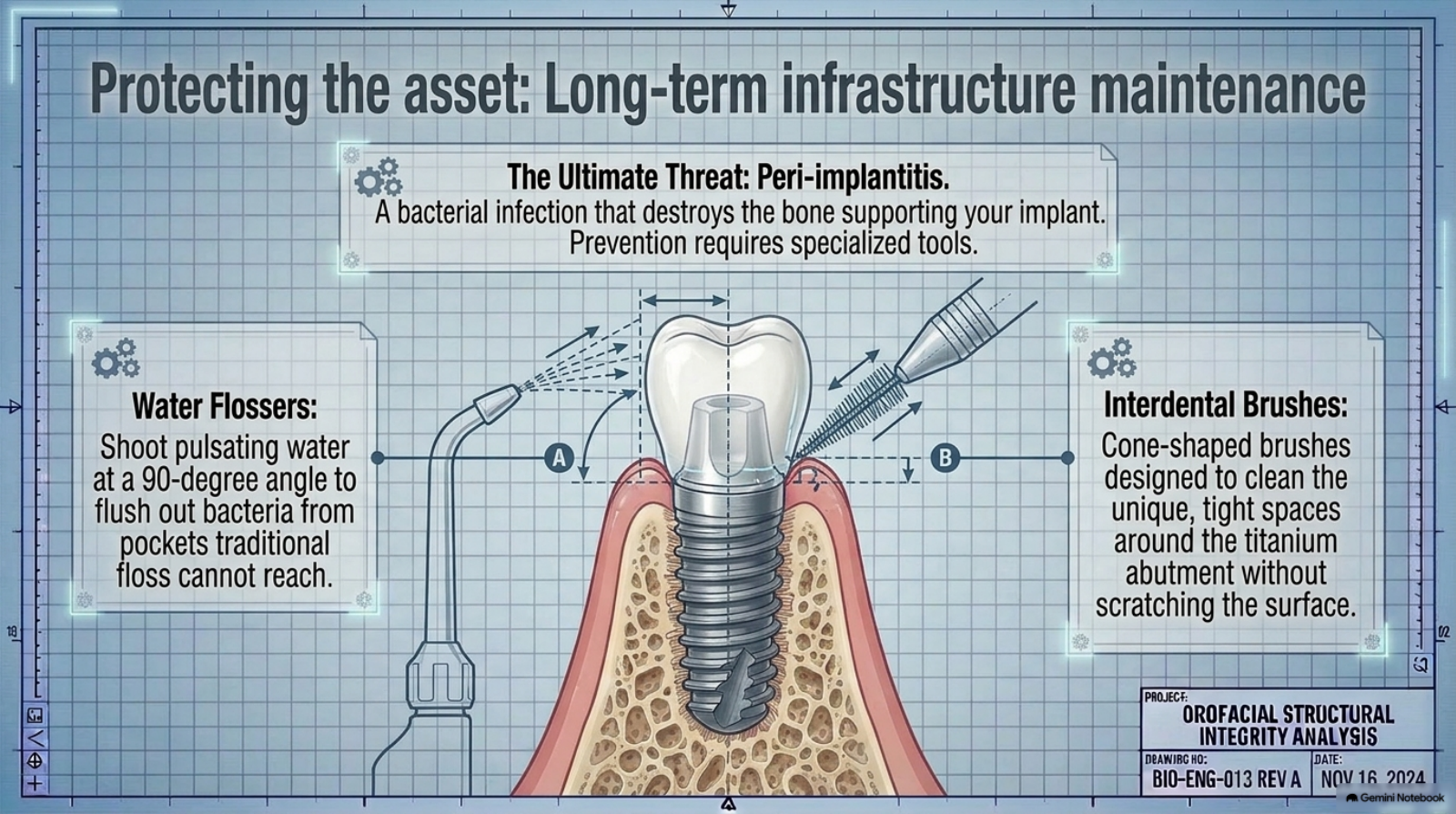
A building that's finished still needs a maintenance plan — and for implants, the threat is specific: peri-implantitis, a bacterial infection that destroys the bone supporting the implant. The deck's defense is two specialized tools. Water flossers shoot pulsating water at a 90-degree angle, flushing bacteria from pockets that traditional floss cannot reach around the implant crown. Interdental brushes — cone-shaped, sized for the tight spaces around the titanium abutment — clean the unique geometry of implant-supported restorations without scratching the surface. The message is simple: implants don't need daily removal or adhesives, but they do need the right tools, used consistently, for the life of the structure.
Slide 15 — The Ultimate Return on a Biomechanical Investment
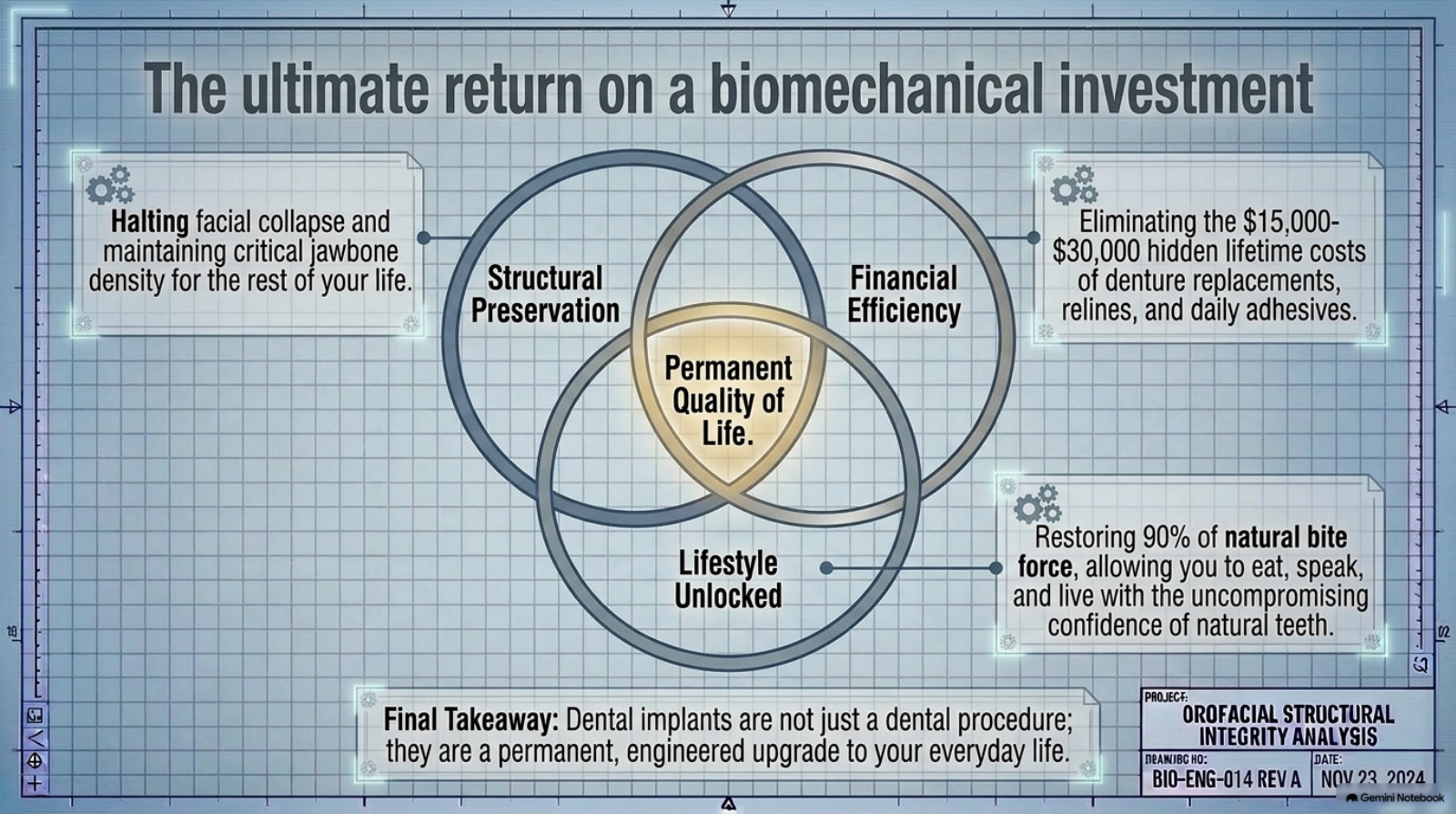
The deck closes where it opened: with the investment thesis, now fully proven. Three circles converge. Structural preservation — halting facial collapse and maintaining jawbone density for life. Financial efficiency — eliminating the $15,000 to $30,000 in hidden lifetime costs of denture replacements, relines, and adhesives. And lifestyle unlocked — 90 percent of natural bite force, the freedom to eat, speak, and live with the uncompromising confidence of natural teeth. Where the three overlap sits the whole point: permanent quality of life. Dental implants are not just a dental procedure; they are a permanent, engineered upgrade to everyday life — and now you know exactly what goes into the build.